USTDC

Photo of USTDC courtesy of Les Duffin

Thursday, October 25, 2007

West Compound

I've been meaning to post these photos from Les and Kent of the HSA West Compound. They don't show all of the buildings but may refresh some memories of what that side of the street looked like. This one was probably taken from the top of the Roma Hotel


This one was probably taken from the roof of the hostel.
The West Compound contained the chapel, bowling alley, gas station, barber shop, game room, snack bar, cops (I think), and a number of other offices.


I've attempted to overlay the building layout that Les provided on top of the area as it appears today. I think that this is pretty close, but if anyone remembers it differently, please post a comment at the bottom of this post.

Sunday, October 7, 2007

Help!

After twenty-eight posts in just under three months, I've just about emptied my memory bank of Taipei and USTDC experiences.

One of my long-term hobbies is genealogy -- the tracing of my ancestry. I began that hobby because no one in my immediate family knew very much about our ancestors and I felt that it was important to assemble as much info as I could find and record it for future generations.

I began recording my Taipei experiences here for basically the same reason. I was unable to find very much information at all about the US Taiwan Defense Command, its history, or the people who served there. I even submitted a Freedom of Information request to Pacific Command headquarters in Hawaii for a copy of the unit's history, but never received even an acknowledgment back from them. It's not worth creating a legal mountain out of this molehill of curiosity, so I'm afraid that the official history of USTDC may never be released.

I was told by an American civilian who lives in Taipei today that most of the younger population of the city have no idea that any American military personnel were ever stationed there.

Anyway, I am officially welcoming any and all comments from anyone even remotely connected to TDC. Here's the deal: If you will contact me by email and let me know what kinds of things you'd like to write about, I will add you as an author to this blog. If you have some experiences or comments that you'd like to share, but prefer not to be added to the list of authors, just write them up and send them to me and I'll be happy to post them here on your behalf.

I may very well remember more things to add here in the future, but right now I'm just about tapped out. I was only there for fifteen months during the 1970s and USTDC was operational for a whole lot longer than that. I hope that some of you will be willing to provide the rest of us with your experiences and insights that I simply don't have.

Thanks in advance for your help.

Don

Tuesday, September 25, 2007

Gambling

Recreational gambling (or gaming, as the industry prefers to call it today) has long been a part of military tradition. I don't know if anyone can say for sure when it began, but we do know that Roman soldiers cast lots to see who would get the robe of Jesus. It's probably safe to say that they weren't the first military gamblers.

When I was stationed at Kadena Air Base on Okinawa from 1963 to 1964, the on-base clubs all had slot machines, which was typical of most overseas bases. Domestic military clubs also had the machines at one time, but they were removed sometime in the early 1950s.

After a series of high profile scandals involving the skimming of funds from the one-arm bandits in Southeast Asia, both the Army and the Air Force removed all of their overseas machines. The Navy and Marines, on the other hand, kept all of theirs in place, including those in Taipei. In 1980, long after I returned home from Taipei, the Army and Air Force overseas clubs once again installed slot machines at most of their locations, which is still the case today.

The profits from these machines, which is approximately the same percentage as those in Las Vegas, goes to pay for other recreational facilities, such as golf courses and campgrounds for military personnel.

In my experience, most military people either don't gamble at all or do so on such a small scale that it doesn't impact their lives in any significant way. However, there are always those who are more prone to addictive behavior, whether it's gambling, alcohol, drugs or something else. While most of us were content to flush a couple of dollars down a slot machine at the club after lunch, the gambling addict could never do that.

The one case that I'll never forget was that of a married Air Force guy who routinely gambled his paycheck away every month. It was said that his children used to ask neighbors for food because there was never enough in their house. Local merchants who extended him credit rarely got any of it back.

His primary addiction was slot machines, though he used to drop by the stag bar at the 63 Club during the brief period when the regulars were shooting craps. I saw one Army guy refuse to accept his bet at the table because he knew what the situation was and didn't want to be a part of making it any worse. It didn't really matter though because this guy always found some way to gamble his money away.

When it finally came time for him and his family to return to the States, he requested three months advance pay. When asked why he needed that much money, he said that it was to pay off all of his bills on Taiwan. His commander reluctantly approved it with the understanding that he would leave the island debt-free. He was told that he was not to leave Taiwan until that was the case.

A day or two after his scheduled flight home, I learned that he was seen playing the slots in the West Compound. To make a long story short, he had put his family on the plane to Seattle (with no money) while he remained in Taipei. When later asked why, he said that he was only doing what he was ordered to do -- not leave the island until he was debt free. It turned out that nobody got paid because he gambled away most of the three months advance pay he had received a couple of weeks earlier.

I debated for a long time whether or not to write about this case. I eventually decided that, as tragic as it was, it was still a part of my experiences there and should be included. I purposely omitted a lot of detail, for obvious reasons. I have often wondered if the guy ever got his life back together. I hope so.

Thursday, September 20, 2007

Pork Chop Soup And Other Delights

It was late on a Saturday night, as I recall, and my Air Force friend Larry and I were headed back to our rooms at the hostel. It had been several hours since we'd last eaten, so we decided to grab a bite at the restaurant in the Roma Hotel, which was located on the corner nearest to the compound.

I don't remember what I ordered, but Larry saw something called pork chop soup on the menu and decided that he just had to try it.

A few minutes later the waiter delivered our food and I can still see the look on Larry's face as he tried to figure out how to eat a bowl of broth with a fried pork shop in it. He managed it somehow, but it wasn't easy. It was fun to watch though.

There were a few food items that I tried only once, like dried squid for example. A Chinese friend talked me into buying some from a pushcart one day and I remember that they grilled it and put it into a small paper bag like the kind you used to get McDonald's french fries in. But -- trust me on this -- dried squid doesn't taste anything like french fries. I tried one and quickly passed the rest to my friend, who happily chewed away on the remainder.

There was one other pushcart item that I avoided altogether. I honestly don't know what it was, but it was usually piled up on the cart and (as I recall) was a sort of yellow-orange color. I always assumed it was probably dried shrimp or something but I never got close enough to see because the smell was just overpowering!

That's not to say that I didn't enjoy most of the local foods. We'd sometimes buy jiaosi (steamed or boiled dumplings) from a street vendor. We could get a plastic bag full of them for very little money and carry them back to the office for lunch. Good stuff!

Long before those little styrofoam cups of instant noodles became the primary diet of poor college students all over this country, I was eating the real kind in Taiwan.

I was more than ready to leave Taipei at the completion of my fifteen month assignment, mostly because I really wanted to get back to my wife and children. But I still have very fond memories of the outstanding cuisine. There are some excellent Chinese restaurants in the city where I now reside but, in my memories at least, Taipei was far better.

Tuesday, September 18, 2007

Ka-Nip, Ka-Nop, And Lessons Learned

I arrived in Taipei a couple of years after Nixon's Ping Pong Diplomacy Initiative, which eventually led to America's recognition of the People's Republic of China and the dissolution of diplomatic relations with the Republic of China in Taiwan. Some of us have pretty strong opinions about that, but I'll not go into them here.

No, my topic today is about the game itself. As a kid growing up in Ohio, I knew what ping pong was, of course. It was a game where you fastened a net to your parents' dinette table and then used paddles to gently lob a little ball back and forth over the net. Though there was a way to keep score, we just tried to see how many taps we could make before the ball missed the table.

Well, at USTDC I learned how the game was really played and it had nothing to do with lobbing the ball gently back and forth. No, this was the US Navy version of Smash-Mouth Ping Pong. Apparently sailors have a fair amount of free time at sea, and it's not like they can go into town and do some window shopping or anything, so many of them dedicate their lives to beating whoever stands across the ping pong table into submission.

We had a table at TDC and would sometimes spend our lunch hours playing the game. I can't say that I ever got to be as skilled as most of those guys, but I did get good enough to beat most of those I played in the years after I left Taipei.

Just across the parking lot from TDC was a fairly primitive Chinese military building with an open air recreation room. We could sometimes see the Chinese troops playing ping pong over there. By the way, this was the same facility from which the troops used to march out to raise and lower their flag, as I discussed in my Flag Raising post.

One day, one of the best players (Navy guy, of course) from TDC told us that he was going to go over and challenge them to some games. He usually wiped the floor with the rest of us and I guess he figured he'd just expand his area of conquest.

We later asked him how it went and he said that he played some games and did pretty well. But he noticed that there was one guy who just leaned back against the wall and watched him play. After our guy had beaten some of their guys, this observer stepped up to the table and picked up a paddle. To make a long story short, that was pretty much the end of our guy's dominance of the Chinese military in the ping pong department.

I believe he told us that he was going to keep going back there to play, but I'm pretty sure he never did. I can't say that I blamed him.

Sunday, September 16, 2007

Bookstore (Supplemental)

I wrote earlier about the bookstore that was near the hostel and the HSA compound. Kent, over at the Taipei Air Station website, was kind enough to send me a couple of photos of the building.

The first was probably taken sometime in the 1960s. The bookstore is on the ground floor and to the right of the picture. The second is the building as it appears today.

Double Ten Day


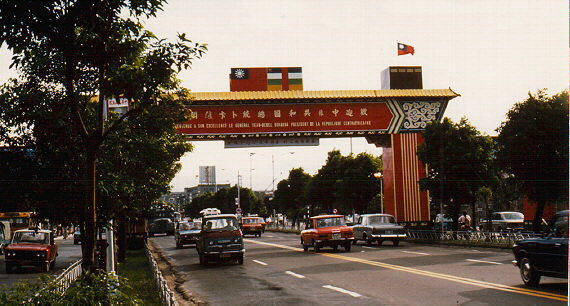
Double Ten Day is to the Taiwanese as Independence Day is to Americans. It's a time of celebration with fireworks and the whole shebang.

But when I think of Double Ten Day, I mostly recall an obscure event that had little to do with the holiday itself.

In the days leading up to the holiday, construction crews erected a number of overhead gates, like the one shown above, around the city. (Photo by Lentz, and courtesy of the 6987th Security Group Website)

I was getting ready to leave the China Seas (63) Club one evening when some guy said that he and a couple of friends were heading back in the direction of the hostel and offered me a lift. Saving a little cab fare sounded good, so I slid into the front passenger seat. Faced with that same situation today, I'd probably consider how much the driver had been drinking before making that move, but I wasn't all that bright back in the 1970s.

So we pulled out of the parking lot without hitting anything, unlike my Army friend John who ran over a local's foot one night with his 240Z, but that's another story. We were almost back to the hostel when we came to the 10-10 gate. I was looking out the side window and not really paying attention to the gate. Neither was the driver, apparently, because suddenly I heard what sounded like a cannon shot and I looked up just in time to see broken pieces of bamboo bouncing off the windshield of the car. It seems that the construction crew had closed off our lane that night while they assembled the gate overhead. We sort of opened it up again.

We drove on to the hostel, where I got out of the car and walked into the building to the sound of sirens pulling into the parking lot. I laid awake for a while that night, fully expecting a knock on the door, but it never came. I guess they didn't figure I was worth the effort of tracking down. Besides, what would they have charged me with anyway -- being stupid enough to ride with a drunk?

No, I don't remember any of the parades, fireworks, or anything else having to do with Double Ten Day, but I'll never forget the night we crashed through that barricade. Some things just stick with you.

Tuesday, September 11, 2007

Books and Tapes

Taipei in the 1970s was a great place to buy books and cassettes. For the benefit of those under 30, cassettes were sort of like MP3 tunes, but they had a very long strip of magnetic tape that was round around two spindles and encased in plastic. You just ran them over your tongue and you could hear music. Okay, I'm kidding about the tongue part.

Anyway, you could buy copies of just about any book, including current best sellers, for a small fraction of their price in the States. The important word here is copies. These looked very much like the originals, including dust covers. The print quality was pretty good, as was the binding. However, if the book happened to contain photographs, they looked pretty much like any photo that you duplicate on a copy machine. You can see what the image is, but that's about all you can say about it.

Cassettes were about the same, though the sound was never quite as good as the originals. Of course when you're talking about the sound quality of cassettes, even the originals weren't all that great to begin with.

There was a great bookstore very close to the HSA compound, and I was a regular customer there. I remember buying The Exorcist the first time I was in the place, on the recommendation of the guy at the desk. Scariest book I ever read, by the way.

I gave it to my good friend Larry, another Air Force type who lived next door to me at the hostel. The next morning, as we were walking to TDC, I asked if he'd had a chance to read any of it. He said, "Yeah, I read a few chapters, then set the book up on the headboard and tried to go to sleep. But I kept hearing all these strange noises so I got up and put it on the table across the room!" It was that kind of book.

The rule on these "copies" was that we were allowed to bring one of each back to the States with us, but no more than that. In other words, you couldn't buy 50 copies of the Encyclopedia Britannica and take them home with you, but you could take one set home. Same for cassettes.

I doubt that there's as much piracy going on in Taiwan today. I was in Korea a few times on business a few years ago and things were pretty much the same there, except that it was mostly computer software.

Monday, September 10, 2007

Taipei Water

I think it was Dean Martin who said that the only water he consumed was frozen and surrounded by scotch.

That wasn't necessarily the case for American GIs in Taipei, but most of us were pretty careful when it came to drinking water. We were told that the Taipei water supply was unsafe to drink or use for cooking. Ice cubes, with or without scotch, were similarly to be avoided. If we went to a local bar or restaurant, we were told, we should order only beer.

Now if you're an American under the age of 30, you might assume that we just went to the store and brought home a case of 1/2 liter plastic bottles of drinking water. Believe it or not, the whole idea of paying actual money to buy everyday drinking water most anywhere in the United States was practically unheard of in the 1970s. Some of us still laugh at the concept, though I'll admit those little bottles, though more expensive than gasoline, are handy for hikes and such.

As part of his services, my houseboy at the hostel lugged in a huge glass bottle of drinking water -- I'd guess somewhere between five and ten gallons -- about once every month or so. I think there was a small charge every time he replaced it, but that was the only cost that I can recall.

Obviously those bottles were very heavy and weren't something you could easily pick up to fill a glass or coffee pot, so they sat in a metal rack that was hinged so you could tilt the bottle. The rack was provided with the first jug of water.

This wine bottle dispenser uses the same principle, but the water bottle racks were of course much larger, usually sat on the floor, and were nowhere near this fancy. It took a little practice to fill up a container without slopping water everywhere, but I eventually developed the right touch.

I never knowingly drank tap water while I was there, but did use it for tooth brushing after a few weeks. I had several friends who didn't bother with bottled water at all, but I was never quite that brave . . . or stupid.

I sometimes wonder if Taipei's water treatment facilities have improved much since the 1970s. I assume so.

Thursday, September 6, 2007

Letters To Mom

Back in 1965-1966, a young sailor by the name of Steve Fehr was stationed with the Navy in Taipei. Like all good sons serving overseas, he wrote his mom on a fairly regular basis and she held on to those letters. Years later, Steve decided to post them, along with his editorial comments, as a draft for a possible book.

Just go to S.S. Fehr's Letters to Mom, scroll down the left column and then click on the first Taipei entry. I should warn you that once you start reading, it's really hard to stop.

Enjoy.